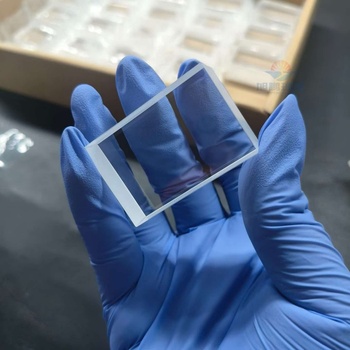
 UV Grade
UV Quartz Glass
High-UV-Transmission Thick Fused Quartz Plate for UV Curing & Disinfection
- 254–365 nm use
- Custom thickness
- Polished
MOQ: 100 pcsDetails

High-UV-transmission thick quartz glass plates for UV equipment are not generic commodity windows. A plate that looks clear in daylight can still absorb critical energy at 254 nm, 285 nm, 308 nm or 365 nm when the optical path is 10 mm, 20 mm or more.
For UV curing chambers, UV-C disinfection tunnels, PCB exposure units, photochemical reactors, UV sensors, analytical instruments and semiconductor tools, the quartz plate is both a window and a process-control component. Buyers should therefore specify transmission at the working wavelength and actual thickness, not only ask for “high-transmission quartz.”
At Dongguan AUVE Glass Co., Ltd., we review your drawing against the UV source, optical path, mechanical load, sealing method and cleaning process before recommending synthetic fused silica, high-purity fused quartz or another suitable grade. Where deep-UV performance matters, the discussion should include hydroxyl (OH) content, metallic impurity level, bubbles and inclusions, fluorescence, solarization risk and whether a spectral transmission curve should be supplied with the batch.
Most global buyers searching for high-UV-transmission thick quartz glass plates for UV equipment have one of three intentions. First, they are replacing a damaged UV window and need a compatible plate quickly. Second, they are sourcing a custom quartz component for a new equipment design and need engineering support. Third, they are comparing suppliers and need proof that the material will maintain transmission after months of UV exposure, cleaning and thermal cycling.
These are different projects. A replacement window requires exact dimensions, hole positions, edge condition and sealing compatibility. A new design allows our engineers to suggest thickness, edge geometry, surface quality and packaging improvements. A supplier comparison requires documented material grade, inspection data, batch traceability and a realistic discussion of total cost of ownership.
Many catalog pages claim “high UV transmission” without stating the wavelength, sample thickness or test method. That is not enough for UV equipment procurement. The information-gain approach is to ask for a transmission curve from 190 to 400 nm, the measurement instrument and the sample thickness. If the plate is 15 mm thick but the test sample was 2 mm, the result cannot be applied directly.
Absorption, surface reflection, scattering from inclusions and polishing quality all increase with optical path length. A thick plate may also require tighter controls on bubbles, striae and edge chipping because every defect can affect yield or safety. For laser applications, ask for laser damage threshold and specify edge-chip limits. For vacuum or pressure sealing, define flatness, parallelism, chamfer, surface roughness and cleaning before packing.


These product directions are suitable for buyers searching high-UV-transmission thick quartz glass plates for UV equipment. Each item can be customized by drawing, and final material grade is confirmed against wavelength, thickness and process conditions.
UV GradeCustom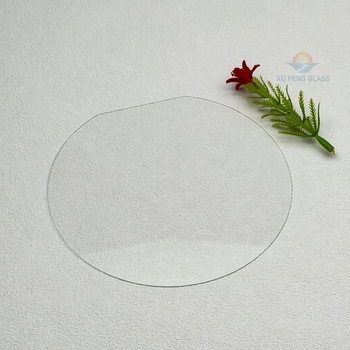
 CNC
Typical capability ranges are shown below for early project planning. Final values are confirmed against your drawing, application wavelength, cleaning method and inspection standard before quotation and production.
| Parameter | Typical Project Range | Why It Matters for UV Equipment | What to Provide |
|---|---|---|---|
| Material Grade | Synthetic fused silica, high-purity fused quartz, natural quartz, selected optical glass | Material grade controls deep-UV transmission, inclusions, fluorescence and solarization behaviour | Wavelength, power density, service life and cleaning chemicals |
| UV Transmission | Custom grade and thickness; verify with spectral curve | “High transmission” is meaningless without wavelength and thickness data | Target transmission at 254 nm, 285 nm, 308 nm or 365 nm |
| OH Content | High-OH and low-OH grades available depending on material | Deep-UV work usually needs a suitable high-OH fused silica; low-OH material may suit other needs | Working wavelength and risk of solarization |
| Thickness | Thin plates to thick-gauge plates; custom review | Thicker paths accumulate absorption and scattering and affect mechanical sealing | Nominal thickness, tolerance and pressure or load conditions |
| Dimensions | Small windows to large equipment apertures | Large plates require careful flatness, handling and packing design | CAD, DXF, PDF or dimensioned drawing |
| Flatness & Parallelism | Standard and precision options reviewed to drawing | Affects optical alignment, sealing and beam uniformity | Required flatness, parallelism and measuring method |
| Surface Quality | Fine ground, etched, polished; scratch/dig and roughness to agree | Surface defects scatter UV light and can create cleaning traps | Surface roughness, visual limits and coating needs |
| Edge & Holes | Seamed, chamfered, C-edge, CNC holes, grooves and cut-outs | Edge chips and micro-cracks can lower strength and create particle risk | Chip limits, chamfer size, hole positions and tolerances |
| Inspection | Dimensional, visual, transmission discussion, batch labeling | Documented inspection reduces incoming QC and assembly risk | Inspection plan, sample size and reports required |
Values are typical planning references only. Final specifications are confirmed by Dongguan AUVE Glass Co., Ltd. against your drawing and agreed test standard before mass production.
Global procurement teams are moving away from informal material descriptions toward measurable specifications, traceable batches and supplier engineering support. These trends affect how high-UV-transmission thick quartz glass plates for UV equipment will be sourced over the next several years.
Buyers increasingly request wavelength-specific transmission curves, sample thickness, test methods and batch identification. A clear quartz window without data is difficult to qualify for medical, semiconductor or high-value UV curing lines.
Supply-chain teams want at least one validated alternative for critical UV plates. Material certificates, batch labels and stable processing documents make it easier to qualify a second production lot without repeating the full design cycle.
UV-C LED systems are expanding, but mercury lamps and excimer sources remain important. Buyers should specify the actual emission spectrum and power density so the quartz grade works across current and future equipment platforms.
Higher irradiance and larger process windows increase thermal load and surface-quality sensitivity. Thick quartz plates must be designed with suitable edge finish, flatness and cleaning access, not selected only by lowest piece price.
Medical, food-contact and electronics customers increasingly ask about RoHS/REACH documentation, cleaning compatibility, packaging cleanliness and particle control. These requirements should be discussed before sample approval.
Fragile quartz plates require more than a standard carton. Procurement teams now evaluate interleaving, corner protection, wooden crate design, labeling, moisture protection and delivery terms as part of the landed-cost decision.
Material suppliers and equipment OEMs are cooperating earlier in design. The goal is not only higher transmission at one wavelength, but repeatable performance through assembly, cleaning, sterilization and long-term UV exposure.
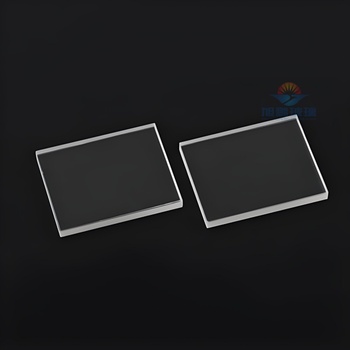

Cleaner deep-UV grades. For UV-C and deep-UV applications, buyers are paying closer attention to high-OH synthetic fused silica, low metallic impurities, inclusions and fluorescence. The objective is stable transmission after high-energy exposure, not just a good initial reading.
Better geometry for sealing and handling. Thick plates are often integrated with metal flanges, gaskets, reactor bodies or sensor housings. Development work is moving toward controlled chamfers, edge polishing, drilled holes with defined chip limits and surfaces that are easy to clean without creating contamination traps.
UV-compatible coatings and surface treatments. Anti-reflective coatings can improve transmission for imaging or sensor windows, but not every coating is suitable for UV-C or high-power exposure. Coating durability, wavelength band, adhesion and cleaning resistance must be evaluated with the base material.
Metrology and digital records. More projects now require dimensional reports, batch labels and traceability from raw material to packed plate. For repeat equipment builds, this data shortens incoming inspection and helps isolate any process deviation quickly.
Design for manufacturing. Our engineers prefer to review sharp corners, deep holes, thin webs and tight edge chips before quotation. Small drawing changes can often improve yield, reduce polishing time and protect the part during shipping.
Dongguan AUVE Glass Co., Ltd. is a deep-processing glass enterprise specializing in the integration of glass product research and development, design, manufacture and sales. Our professional processing and production covers flat and curved tempered glass, ultra-white glass, laminated glass, painted glass, LCD glass, advertising glass, touch screen glass, intelligent control panel glass, LED lamp glass, instrument glass, AR glass (high-transmittance glass / anti-reflective glass), AG glass (anti-glare glass) and a series of high-quality glass products.
For UV equipment projects, our team supports precision cutting, CNC shaping, edging, drilling, chamfering, polishing, cleaning review and export packing for quartz and optical glass components. We adopt advanced production technology and strictly implement production according to agreed standards, with a production management system and comprehensive quality management approach. Our products are known for reliable quality, strong safety awareness, flexible service and export experience.
Dongguan AUVE Glass Co., Ltd. adheres to the corporate development philosophy of “focusing on high-end glass, pioneering and innovating.” We continue to strengthen high-quality talent and advanced production equipment, follow a sustainable development path and cooperate with manufacturers at home and abroad to provide reliable high-quality glass and overall solutions.
Our profile shows a response rate of 82.86% and an average response time of ≤7 hours. Total employees are 51–100 people, and our business type is manufacturer and trading company. Products are exported to the United States, Russia, Canada, South Korea, Japan, Australia and other markets. For buyer confidence, our website provides onsite verification, credit index, transaction level, trade capacity, ratings, reviews and trade history pages.
These are the questions our engineering team receives most often from purchasing managers, equipment designers and quality engineers sourcing high-UV-transmission thick quartz glass plates for UV equipment.
They are used as UV-transparent windows, chamber viewports, curing plates, disinfection barriers, exposure masks, sensor windows and photochemical reactor components. Typical equipment includes UV curing systems, UV-C disinfection tunnels, PCB exposure units, analytical instruments and semiconductor tools.
Specify transmission at the working wavelength and the actual plate thickness, not only a generic high-transmission claim. For critical projects, request a spectral transmission curve from 190 to 400 nm, the test method, sample thickness and batch traceability from Dongguan AUVE Glass Co., Ltd.
Yes. Absorption, surface reflection, scattering and inclusion effects all increase with optical path length. A 20 mm plate can show lower transmission than a thin witness sample from the same material, so transmission should be quoted at the real thickness or supported by measurement data.
Synthetic fused silica is often preferred for deep-UV and UV-C applications where low impurities, low fluorescence and resistance to solarization matter. Natural quartz can be cost-effective for less demanding curing or inspection windows. The final grade should be confirmed against wavelength, power, thickness and service life.
Yes. Send a CAD, DXF, PDF or dimensioned drawing with thickness, tolerance, flatness, surface quality, edge profile, holes and quantity. Our engineers review manufacturability before production and can advise on cutting, CNC edging, drilling, chamfering, polishing and cleaning.
Options include fine ground, polished, seamed, chamfered, C-edge and drilled holes with agreed chip limits. Surface roughness, flatness and parallelism are confirmed against the drawing. UV AR coating or protective coatings may be evaluated when they do not compromise the required wavelength band.
For qualified projects, Dongguan AUVE Glass Co., Ltd. can discuss transmission data, dimensional inspection, visual inspection for chips and bubbles, and batch labeling. The exact test method and documentation package should be agreed before order placement.
MOQ depends on material, thickness, coating and processing. Many optical and quartz projects start from prototype quantities, while production parts may require 50 to 100 pieces or more. Lead time is confirmed after drawing review, material availability and inspection requirements are clear.
Use interleaving film or paper, foam corner protection and fumigation-free wooden crates or reinforced cartons. Each package should be labeled with batch, size and inspection status. Dongguan AUVE Glass Co., Ltd. can support FOB, CFR, CIF, EXW, DDP, DDU, DAF and express delivery discussions.
Select the correct UV-grade fused silica, avoid unsuitable low-OH material for deep UV, keep surfaces clean and specify safe cleaning procedures. For high-power UV, discuss wavelength, power density, duty cycle and expected service life with our engineers before material selection.
Send the drawing, material grade if known, dimensions, thickness, transmission target at the working wavelength, surface and edge requirements, holes, quantity, destination and delivery terms. Email info@auveglass.com for an engineering review.
The company profile shows a response rate of 82.86% and an average response time of within 7 hours. For technical review, email info@auveglass.com with your drawing, wavelength, thickness and quantity.
Share your size, thickness, working wavelength, transmission target, surface quality, edge profile, holes, quantity and delivery terms. Our team will confirm material direction, process route and lead time — usually within 7 hours.
info@auveglass.com