Eight Polished Glass Products Supplied Into France
These are production references, not catalogue filler. Every part below is already being polished, coated or tempered in our Songshan Lake plant, and each one can be re-engineered in size, thickness, edge profile, hole pattern, printing and coating to match your drawing. Where a reference is close but not exact, our engineers will propose the nearest manufacturable route before you commit to tooling.

Ultra-white Tempered Glass, AR Anti-Reflection Coatable, High Light Transmittance
Low-iron substrate with a polish that leaves no haze, ready for single or double-side AR deposition. Suited to display covers and showcase glazing where the green edge tint is unacceptable.
View specification
Custom Ultra-White Clear Tempered Glass Socket Decorative Cover for Stairways
Ultra-white switch and socket surrounds with CNC cut-outs, chamfered apertures and silk-screen icons. A typical specification for French interior fit-out and hospitality refurbishment packages.
View specification
Ultra-thin Optical Glass Sheets Schott B270 / D263T — Blank Cutting & Processing
Thin borosilicate blanks cut, lapped and polished for wafer-level packaging, sensors and micro-optics. Tolerances and surface quality are agreed against your optical drawing.
View specification
High-transmittance AR Coated Optical Glass, Ultra-clear Tempered Glass
Combines a tempered low-iron core with a durable anti-reflective stack, cutting surface reflection to roughly 0.5–1% per side. The default choice for touch modules and instrument windows.
View specification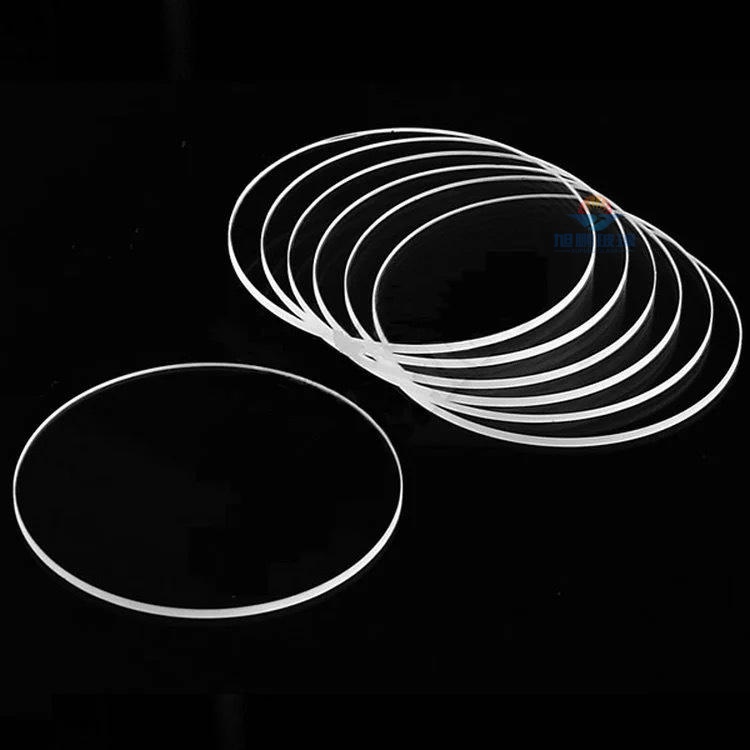
Corning EXG Alkali-Free Glass, UV High-Transmittance Optical Window Substrate
Alkali-free aluminoborosilicate with a low coefficient of thermal expansion, double-side polished for MEMS, photolithography masks and UV window applications in French photonics labs.
View specification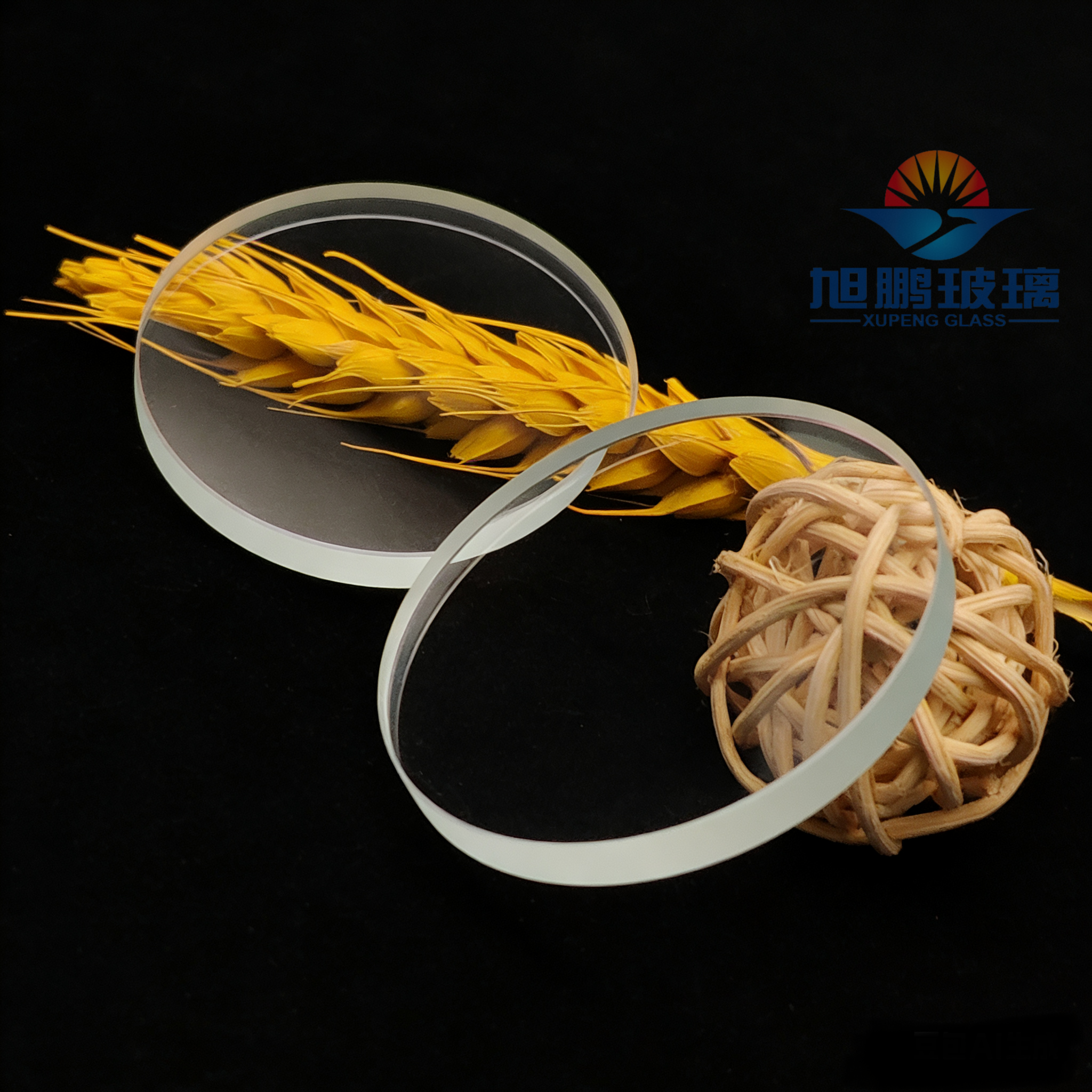
Low Iron Round High Transmittance Tempered Glass Panel, Precision Polished Edges
Circular low-iron panels with a fully polished, chip-free rim — the specification French lighting and furniture designers ask for when the edge itself is the visible product.
View specification
Round Aluminosilicate Glass with Chamfered Ground Edges and Metal Coating
Aluminosilicate substrate chosen for thermal and chemical durability, then chamfer-ground and metallised. Used for control dials, sensor covers and premium appliance interfaces.
View specification
High-transmittance Anti-Reflection Coated Glass
Broadband AR stack applied over a precision-polished surface, so scatter stays low and contrast stays high. Ideal for museum vitrines, HMI panels and optical instrument windows.
View specificationA Supplier Profile French Procurement Teams Can Check
Before an RFQ is raised, French buyers typically want to know one thing: can this factory be verified, and will it still answer the phone in month nine of the program? The figures below are drawn from our published company profile, onsite assessment and transaction records.
Where Polished Glass Creates Value in France
France is not a single market — it is a set of highly differentiated industrial clusters, each with its own acceptance criteria. Our polishing routes are tuned to the failure modes that matter in each one, from coating adhesion under thermal cycling to edge-chip limits on visible components.
Aerospace & Defence, Occitanie and Nouvelle-Aquitaine
Cockpit display covers, sensor windows and instrument bezels around the Toulouse and Bordeaux aerospace clusters demand repeatable coating adhesion, low outgassing and full material traceability. A poorly polished edge is where fatigue cracks begin, so chamfering and fire polishing are specified as a functional requirement rather than a cosmetic one.
Luxury, Fragrance & Retail, Île-de-France and Centre-Val de Loire
Counter vitrines, display plinths, decorative panels and point-of-sale components live or die on optical purity. A trace of green edge tint or a single visible polish scratch will fail a French luxury house's sample review. Ultra-white low-iron substrates with hand-finished edges are the standard, not the exception.
Photonics, Optics & Semiconductors, Île-de-France and Auvergne-Rhône-Alpes
Corning EXG, Schott B270 and D263T, K9, fused silica and sapphire are lapped and polished into wafers, windows, beamsplitter blanks and flow cells. Surface roughness, flatness and scratch-dig standards are agreed before the first blank is cut, because in photonics a polishing deviation becomes a measurable loss budget item.
Automotive & E-Mobility HMI, Hauts-de-France and Grand Est
Centre-stack displays, passenger screens and instrument clusters benefit from AG anti-glare etching paired with an AR stack on the inner face. The result is a readable interface in low winter sun and in tunnel lighting, without the fingerprint pickup that uncoated glass suffers in shared-vehicle fleets.
Medical Devices & IVD, Auvergne-Rhône-Alpes and Occitanie
Sapphire viewports, quartz cuvettes, flow-cell windows and instrument glass for analysers. Edge chipping is the dominant in-service failure mode in diagnostic hardware, so every medical blank is inspected under magnification before packing, and batch records are retained for recall traceability.
Architecture, Lighting & Fit-Out, Nationwide
Tempered low-iron panels for light fittings, illuminated signage, balustrades and interior partitions. Because French daylight design increasingly pushes light deeper into floor plates, high-transmittance glass with a stable edge finish lets specifiers hit daylight targets without adding luminaires.
French Market Trends Reshaping Glass Sourcing in 2025 and Beyond
Glass purchasing decisions in France are no longer driven by unit price alone. Regulatory pressure, reindustrialisation policy and consumer expectations have shifted the weighting toward documentation, recyclability and supply resilience — and those factors now shape how a polishing specification is written.
Reindustrialisation and Dual Sourcing
France 2030 and the European Chips Act have pushed optical and semiconductor-adjacent components up the strategic agenda. Buyers increasingly nominate a European finishing partner for critical steps while retaining an Asian partner for scale and custom variety. Suppliers who can document process control precisely are the ones who survive that screening.
AGEC Law, EPR and Circular Design
Extended Producer Responsibility and the French repairability index now reach into packaging and electrical equipment. Material declarations, lighter glass gauges, RoHS-compliant coating stacks and recyclable packing are moving from "nice to have" to tender requirements for suppliers selling into French retail and building channels.
RE2020 and Daylight-Driven Glazing
RE2020's emphasis on daylight autonomy and summer comfort is pushing specification toward high-transmittance low-iron glass with controlled solar factors. That raises the bar on edge polishing and coating uniformity, because defects that were invisible in thicker architectural glass become obvious in thin high-clarity panels.
High-Mix, Low-Volume Premiumization
French luxury houses, design studios and hardware startups want 10 to 50 pieces with photo-perfect edges — quantities that traditional glass plants refuse. Flexible polishing cells with quick-change fixturing are turning this from an impossible order into a routine one, and buyers are consolidating those small runs with one responsive supplier.
From Raw Sheet to a Polished Part That Passes Incoming Inspection
Polishing is the step that decides whether a glass component feels premium or industrial. Every route below runs in-house at our Dongguan facility, which means tolerances, edge quality and coating adhesion are controlled by one team rather than negotiated between three subcontractors.
Cutting and Shaping
Automatic and CNC cutting from float, low-iron, borosilicate, quartz and optical stock, including circular, obround and irregular profiles cut to your DXF.
Edge Grinding, Chamfering and Fire Polishing
Flat, arris, pencil and chamfer geometries with controlled chip limits. Fire polishing is applied where a transparent, mirror-smooth rim is required.
Double-Side Lapping and Precision Polishing
Mechanical polishing to agreed flatness, parallelism and surface roughness targets, with scratch-dig and haze results reported per batch.
Tempering and Thermal Strengthening
Flat and curved thermal tempering that raises strength to roughly four to five times annealed glass, with fragmentation testing on witness samples.
AR / AG Coating and Silk-Screen Printing
Single or double-side anti-reflective deposition, anti-glare etching, mirror and metal coatings, plus high-temperature ceramic ink printing with IR windows and icons.
Optical Inspection and Export Packing
Dimensional, visual and transmittance checks under controlled lighting, followed by interleaving film, foam corners and fumigation-free crates built for fragile sea freight.
Substrate Selection Matrix for Polished and Coated Glass
Most sourcing errors are material errors. Use the matrix below to narrow the substrate before you send a drawing, then let our engineers confirm the final polish, coating and tempering route against your test standard.
| Substrate | Typical Optical / Physical Property | Best-Fit French Applications | Polishing & Finishing Options |
|---|---|---|---|
| Ultra-white low-iron tempered | ~91% visible light transmission, neutral edge, strength ~4–5× annealed | Retail vitrines, control panels, LED luminaires, light boxes | CNC shaping, edge polishing, silk-screen, AR or AG |
| AR coated glass | Surface reflection reduced to roughly 0.5–1% per side | Touch modules, all-in-one displays, museum and instrument windows | Single/double-side AR, tempering, printing |
| AG anti-glare glass | Micro-etched surface diffuses reflections; haze and gloss selectable | Outdoor LCD, industrial HMI, kiosks, automotive centre stacks | Etched AG, AG + AR combination, tempering |
| Silk-screen printed tempered | Fired ceramic ink fused into the glass surface for permanent graphics | Appliance panels, instrument fascia, switch and socket covers | Multi-colour printing, IR-transparent windows, drilled holes |
| K9 optical glass | Borosilicate crown, refractive index nd ≈ 1.5168, low inclusion count | Lenses, prisms, optical instrument windows | Precision polishing, AR coating, CNC edging |
| Fused quartz | High UV transmission with excellent thermal shock resistance | UV curing, disinfection equipment, high-temperature viewports | Thick-gauge cutting, lapping, drilling, fire polishing |
| Sapphire | Mohs hardness 9, melting point approximately 2,040 °C | Sensor covers, high-temperature and scratch-critical windows | Cutting, polishing, chamfering, metallisation |
| Corning EXG alkali-free | Alkali-free aluminoborosilicate, low CTE around 3.2 ppm/°C | Semiconductor wafers, MEMS, display substrates | Double-side polishing, wafer dicing, edge profiling |
| Schott B270 / D263T | High-clarity borosilicate thin glass with good chemical durability | Sensor lids, micro-optics, thin display covers | Ultra-thin lapping, polishing, blank cutting |
| Aluminosilicate | Improved thermal and chemical resistance versus standard soda-lime | Control dials, premium appliance interfaces, sensor covers | Chamfer grinding, polishing, metal coating |
Values shown are typical reference data for early material selection. Final specifications, tolerances and acceptance criteria are confirmed against your drawing and agreed test standard before mass production begins.
Why French Buyers Shortlist Dongguan AUVE Glass
Dongguan AUVE Glass Co., Ltd. is a deep-processing glass manufacturer integrating R&D, design, production and export under one roof, based in the Songshan Lake science and optoelectronics cluster of Dongguan, Guangdong. We process flat and curved tempered glass, ultra-white, laminated and painted glass, LCD and touch screen cover glass, smart control panel glass, LED lighting glass, instrument glass, AR high-transmittance glass and AG anti-glare glass.
Guided by our operating philosophy of "focusing on high-end glass, pioneering and innovating", we keep investing in skilled engineers and advanced equipment so that OEMs, brand owners and distributors receive a complete glass solution rather than a single processing step. Production follows defined process standards and a documented quality management system, which means every batch is traceable from raw sheet to packed carton.

Factory-Direct, No Trading Markup
You buy from the plant that cuts, polishes, tempers and coats the part. That removes one layer of margin and, more importantly, one layer of accountability when a tolerance question arises.
Closed-Loop Production
Cutting, CNC edging, drilling, tempering, silk-screen printing, AR/AG coating and inspection all run in-house, so an edge-polish change does not require renegotiating with a third party.
Drawing-Driven Engineering Review
Send a CAD, DXF or PDF drawing with thickness, tolerance, edge, hole, printing and coating requirements. Our engineers assess manufacturability and flag risk points before production rather than after the first reject.
Small Batches to Volume Runs
Coated and optical parts commonly start from 10 to 50 pieces, while standard ultra-clear tempered parts typically start between 100 and 500 pieces. Sample and pilot quantities can be discussed for new programs.
France-Ready Export Logistics
We support FOB, CFR, CIF, EXW, DDP, DDU, DAF and express delivery, with fragile-goods packing designed for sea freight into Le Havre and Marseille-Fos or air freight into Paris CDG.
Fast, Documented Communication
Average inquiry response time is within seven hours. Technical questions, coating data and packing photos are answered by the same engineering contact throughout your program.
Frequently Asked Questions from French Glass Buyers
These are the questions French procurement and engineering teams raise most often during first contact. If your question is not covered here, an engineer will answer it directly.
Do you export polished glass to France, and which Incoterms do you normally use?
Yes. We regularly ship to France alongside our established markets in the United States, Canada, Russia, South Korea, Japan and Australia. Standard terms are FOB, CFR, CIF and EXW, with DDP, DDU and DAF available where your customs setup supports them, plus express courier for samples and small batches. For French buyers, sea freight into Le Havre or Marseille-Fos is the usual route for volume orders, while air freight into Paris CDG suits urgent qualification samples.
Can you supply documentation to support CE marking, REACH and RoHS compliance?
We provide material declarations and process documentation that your compliance team can use when building the technical file for CE marking, REACH screening and RoHS assessment. Because the final product's conformity is determined by the finished assembly, not the glass alone, we work to the specific declaration format your notified body or compliance consultant requires, and we flag any coating or ink chemistry that needs additional review before the order is released.
How do you support French EPR (extended producer responsibility) and AGEC obligations?
We can supply material composition data, packaging weight breakdowns and recycled-content information so that your EPR declarations and repairability assessments are based on accurate inputs. Where a project needs lighter gauges, mono-material packing or reduced coating layers to lower the environmental footprint, our engineers will propose a specification that still meets the optical and mechanical requirements.
What is the minimum order quantity for a French pilot program?
MOQ depends on material and process rather than on destination. Many coated and optical glass parts start from 10 to 50 pieces, while standard ultra-clear tempered parts usually start between 100 and 500 pieces. For a new French program we can quote a sample set first, then a pilot batch, and only then move to production volumes — so you are not forced to commit to a full run before the design is validated.
What lead times should we expect for samples and for repeat production?
Sample lead time depends on whether new tooling or a new coating recipe is required, and is confirmed at quotation stage. Repeat production is faster because the process route, fixtures and inspection plan are already frozen. Inquiries are answered on average within seven hours, and we confirm both dates in writing before you place a purchase order, so your French assembly schedule can be built on a stated commitment rather than an estimate.
Can you produce glass strictly to our own CAD or DXF drawings?
Yes. Send a CAD, DXF or PDF drawing with thickness, tolerance, edge condition, hole positions, printing artwork and coating requirements. Our engineers review manufacturability before production covering CNC cutting, edging, drilling, tempering, silk-screen printing and AR or AG coating, and will come back with any tolerance that cannot be held economically — before metal or fixturing is cut.
Do you provide inspection reports and material certificates with each shipment?
Yes. Dimensional and visual inspection results are recorded per batch, and optical properties such as transmittance, haze or gloss are measured where the specification calls for them. Material certificates for the raw substrate and coating data sheets are supplied on request so that your incoming inspection team in France has a document set to compare against the purchase specification.
How is fragile glass packed for sea freight to France?
Every order is packed for the transport mode it will actually travel by: interleaving film or paper between parts, foam corner protection, reinforced cartons or fumigation-free wooden crates, batch and cavity labelling on the outside, and a packing photo set sent before dispatch. If your French warehouse or 3PL has its own labelling or pallet configuration requirements, send them at order confirmation and we will build the packing plan around them.
Which substrates can you polish, and can you recommend one for my application?
We polish ultra-white low-iron glass, standard soda-lime, borosilicate, aluminosilicate, K9 optical glass, fused quartz, sapphire, Schott B270 and D263T, and Corning EXG alkali-free glass. If you describe the operating environment — temperature range, abrasion exposure, optical targets and mounting method — our engineers will recommend a substrate and polishing route, then send a reference sample so your team can evaluate it physically before specification sign-off.
Send a Drawing. Get an Engineering Review Within 7 Hours.
Share your size, thickness, tolerance, edge profile and coating requirements. Our team will confirm the substrate, the polishing route, the inspection plan and the lead time — and quote against the specification you actually need, not a generic catalogue item.